
For Fitters and Shop Owners
How to Fit a Golfer for Scoring Clubs
Most fitting carts get built around the driver and the iron set. The wedges inherit whatever length and shaft came with the irons, and the putter never gets measured at all. That is an opening. Here is how to fit the scoring end of the bag properly, and why it is the most useful work an independent shop can sell.
Open a Wholesale AccountWhy the Scoring End Is Worth Building a Service Around
Because hardly anyone is doing it, and because the clubs involved are the ones that decide a score. Driver fittings are crowded. Every launch monitor within an hour of you is pointed at a driver. Meanwhile the same golfer is carrying a pitching wedge, a sand wedge and a lob wedge that were never measured, never gapped and never matched to each other, plus a putter that came off a rack.
A scoring fitting also fits the way a small shop actually runs. It needs less bay time than a full bag fitting, it happens at distances you can see with your own eyes, and it produces a build list rather than a maybe. And unlike a driver, wedges wear out, which means a scoring customer comes back on a cycle instead of once every four years.
The wider argument for why an independent beats a chain on work like this lives on competing with the major OEMs. This page is the technique.
Where the Set Actually Breaks
The hole is almost never between the sand wedge and the lob wedge. It sits between the pitching wedge and whatever the golfer bought next, and it is usually bigger than either of you expects.
Iron sets have gotten progressively stronger through the scoring end over the last two decades, and a pitching wedge that was once a known quantity now covers a wide range depending on the model. The golfer does not know that. They bought a set, then bought a 56 and a 60 because that is what the rack had, and nobody ever put a number on the space in between. As a reference point you can trust, Alpha's own Vx pitching wedge is 46 degrees. Measure the set in front of you against something published and you will see the drift immediately.
So do not fit by the number stamped on the sole. Fit by carry.
Worked example
The same golfer, before and after the scoring end gets measured
As the bag walks in
15 yd35 yd hole60°9556°110PW145
After the fitting
16 yd16 yd17 yd58°9654°11250°128PW145
80120160
Carry distance in yards. One example from one golfer, not a rule. Your customer's numbers will be their own, which is the entire point of measuring them.
Read the top track and the problem is obvious once it is drawn. The bottom two clubs are 15 yards apart and perfectly sensible. The gap above them is more than double that, and it sits at a distance the golfer faces constantly. They have been covering it by swinging a 56 harder or a pitching wedge softer, which is exactly the shot that produces a card full of bogeys.
Measure on their ball. A range ball and a premium ball do not carry the same distance out of a wedge, and the difference grows as loft goes up. If you gap a set on range balls, you have gapped it for a golfer who does not exist.
How to Run the Session
Start with what they already own, measure it, and only then talk about what to change. A scoring fitting that opens with a product recommendation is a sale, not a fitting, and shop owners can tell the difference even when golfers cannot.
1
Inventory and measure what is in the bag
Every scoring club on the loft and lie machine before anything else. Record what you actually find, not what is stamped on the head, and note the length and the grip condition while it is in the clamp.
What you are watching forWedges drift. A set that has been bent once, or bought used, is not the set on the receipt.
2
Establish the reference number
Get a reliable full pitching wedge carry on their ball. That number is the top of the ladder and everything below it gets spaced off it. Take enough swings that you are working from a middle, not from their best one.
What you are watching forTheir comfortable carry, not their career shot. Fit the swing that shows up on a Saturday.
3
Work down the bag in yards, not in degrees
Set the target carry for each club below the reference, then choose the loft that gets there for this golfer. Loft is how you arrive at even gaps. It is not the thing you are fitting.
What you are watching forEven spacing all the way down. A tidy bottom end hides an ugly top end more often than not.
4
Watch turf entry on real turf
Move to grass for the sole work if you have any grass at all. Hit the same shot from a tight lie and from something softer, and look at where the club enters the ground rather than at the ball flight.
What you are watching forA mat forgives a leading edge that a wet fairway will punish. Bounce errors hide indoors.
5
Check the short irons and the putter before they leave
Take two minutes on the 8, 9 and pitching wedge lies, and put the putter on a board. You are not selling anything yet. You are showing them a number they have never been shown.
What you are watching forThe two parts of the bag nobody fits, and the easiest second appointment you will ever book.
On the benchA scoring fitting ends the same way every fitting ends, with someone writing the numbers down and building the club to them.

Read the Turf Interaction Instead of Guessing at Bounce
Choose sole width and bounce from what the ground tells you, not from a chart. The chart is where you end up. The divot is how you get there.
Hit three from a normal lie. What does the ground look like afterwards?
Deep and steep
The club is arriving on a sharp angle and digging. More effective bounce and a wider sole will hold them up. Confirm it from a soft lie, where digging gets worse, not better.
Shallow or sweeping
The sole is skidding and the leading edge is not getting under the ball. Less bounce and a narrower or more relieved sole gives them the edge back. Confirm it from a tight lie.
Inconsistent both ways
Do not touch the sole yet. Digging on some and thinning on others is usually a low point that is moving. Check lie and length first, and fit the bounce once the strike settles.
Then write down what you saw. A one line note on the ticket that says which sole worked from which lie is worth more at the next appointment than anything the golfer will remember about the session.
The reason that diagnosis is worth doing is that the stamp on the sole tells you almost nothing on its own. Here are three wedge families sitting on the same shelf, with their published bounce:
Wedge family
52 degrees
56 degrees
60 degrees
Alpha ProSpec
9°bounce
12°bounce
4°bounce
Alpha PF-2
8°bounce
10°bounce
4°bounce
MDC Tour
8°bounce
14°bounce
4°bounce
Published specifications for three families Alpha carries. Look at the 56 degree column. Ten degrees of bounce and fourteen degrees of bounce are not the same club, and a golfer who was sold "a 56" has no idea which one they are carrying. This is the whole argument for fitting the scoring end rather than selling it off a rack. What to actually carry on your shelf is a stocking question, and that is on what components a clubfitter should stock.
If your customer wants to understand what you just did to them, that is what the consumer guides are for. Send them Wedge Bounce Explained or How to Choose Golf Wedges after they leave. Your job in the bay is the diagnosis, not the lecture.
Three Ways to Close a Gap, and What Each One Costs
Bend a wedge, add a wedge, or rebuild the scoring end as a matched set. All three close the hole. They do not cost the same thing, and picking the wrong one is how a good fitting turns into a return.
Bend what they already own
Right when the hole is small, the head is forged or a bendable cast, and the golfer likes the wedges they have.
What it costs: effective bounce moves with loft, roughly degree for degree, so bending two degrees strong also takes about two degrees of bounce away. Check the lie afterwards, and know the head's limit before you put it in the machine.
Add a club
Right when the hole is too big to bend out, or the heads are at their limit, or the lofts they need do not exist in the family they own.
What it costs: something has to come out of the bag. Decide with them which club leaves before you order anything, because that is the conversation that stalls a build after it has been paid for.
Rebuild the scoring end together
Right when the wedges are a collection rather than a set: different lengths, different shafts, different eras, different feels.
What it costs: the biggest ticket and the most trust. This is usually the second visit, not the first. Close the gap cheaply today and earn the rebuild later.
Photo slot
Wanted here: a wedge clamped in the loft and lie machine, mid-bend, with the bar in shot. Close in, landscape, shallow depth of field. This is the photo that proves you do the work rather than just order the parts. Send it over and this block gets replaced with the photo.
Whichever route you take, the numbers behind it belong on a written price list before the customer walks in. That is covered on how to price repairs and custom builds.
The Build Variables Most Shops Skip
Length, lie, head weight and shaft weight all get inherited from the iron set instead of being chosen. On a wedge, every one of them is a fitting decision.
On the bench
What you are actually looking at when a wedge is soled
- Leading edge. How high it sits is what the golfer feels off a tight lie. Start here when they thin one.
- Sole. Width and camber decide how the head releases through turf. Judge it from the divot, not from a chart.
- Bounce, at address. It moves with loft roughly degree for degree, so every bend you make changes it too.
- Face. Put a real number on it with the machine. The stamp is a starting guess, especially on a used club.
- Shaft and lie. The more loft a club has, the more a lie error turns the face. Set it on a board, not by eye.
- Length. Wedges are commonly built at or just under the length of the shortest iron in the set, and a slightly shorter wedge is easier to control. It also moves the low point. Decide the length deliberately and note it, rather than letting the supplier's standard decide it for you.
- Lie. This is the one that matters most and gets checked least. The more loft a club has, the more a lie error rotates the face at impact, so the same couple of degrees you can live with in a 6 iron shows up as real dispersion from 100 yards. Check it on a lie board or with sole tape and set it.
- Head weight and swingweight. Heavier heads on shorter shafts are what make a wedge feel like a wedge. When a customer says a wedge feels light or whippy, that is usually a build answer rather than a different head.
- Shaft weight through the transition. If the iron set runs light and the wedges run heavy, the golfer feels a step change at exactly the clubs that need the most touch. Match the feel across the transition instead of letting two separate purchases collide.

Weight is the variable, and it is a fitting decision before it is a buying one. What you are aiming for is continuity from the short irons into the wedges, so nothing changes under the golfer's hands at the clubs that need the most touch.
That last one is a stocking question as much as a fitting one, and it is easier to answer when you can order the pieces one at a time instead of committing to a rack. Talk it through with us on your wholesale account rather than guessing which builds to keep on the shelf.
The Rest of the Scoring Set
The scoring set is not three wedges. It is everything from the 8 iron down, plus the club they use more often than any other in the bag.
On short irons, lie angle is the variable and the progression is the thing to look at. A published set gives you a reference for what a sensible progression looks like, so you can tell at a glance whether the set in front of you has been bent, mixed or built by three different people.
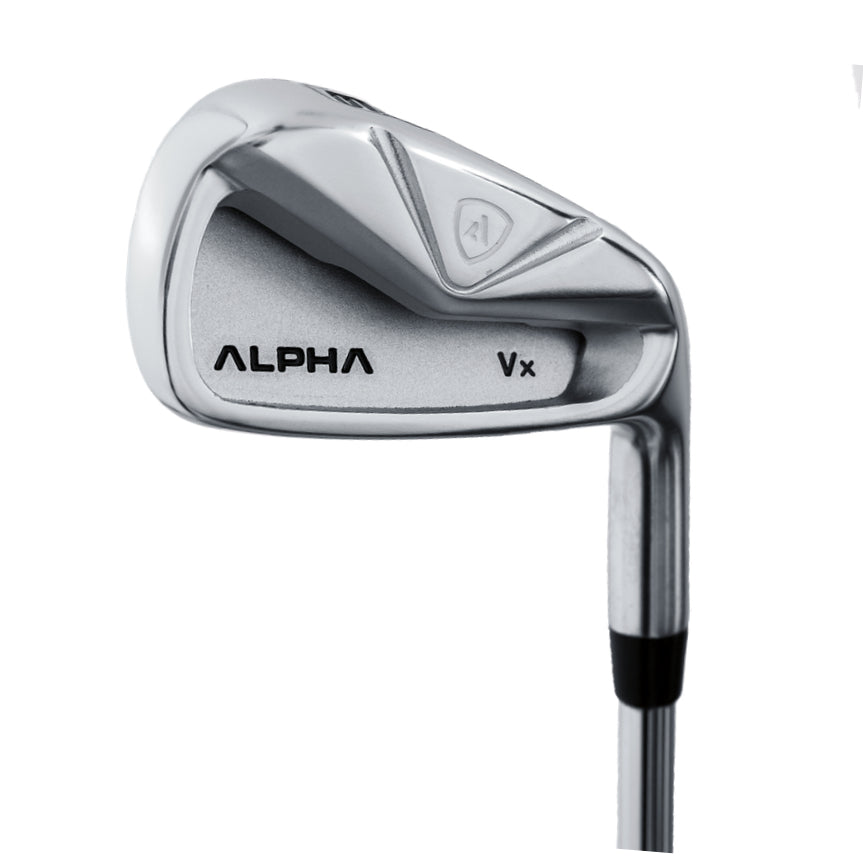
Loft, PW46 degrees
Lie, PW63.5 degrees
Bounce, PW6 degrees
Head weight292 g
Alpha Vx iron, pitching wedge specifications as published. Across the scoring end of that set the lie steepens and the bounce climbs one degree per club as the shaft shortens, which is the pattern a well built set should show. Hold a customer's set against a progression like this and a bent or mismatched club announces itself.
Then the putter, which is the easiest fifteen minutes in the shop and almost nobody spends them. Four things, in this order, and then a roll on a surface close to the speed they actually play rather than on whatever your carpet does.
At address
The four measurements a putter fitting actually turns on
- Length. Off their posture, not off their height. Everything after this depends on getting it right first.
- Eye line. Over the ball or just inside it. Move the length until that is true, then leave it alone.
- Shaft lean. Whatever lean they deliver comes straight off the loft on the head. Fit the loft to the lean.
- Lie. The sole has to sit flat. A toe-up putter starts the ball offline before the stroke has done anything.
Pick the head style off the shape of their stroke while you are down there. None of it requires equipment you do not already have, and it is the single most underserved fitting in most markets.
Why Scoring Customers Come Back
Because wedge faces are a consumable and drivers are not. Sand, volume and practice all wear a face down, and the shots that suffer first are the part-swing ones the golfer already finds hardest. A face that looks fine can still feel dead, and running a fingernail across the grooves will tell you more in two seconds than looking at it will.
Photo slot
Wanted here: a worn wedge face, shot close and raked with side light so the grooves and the wear pattern actually read. Ideally next to a fresh one for contrast. This is the picture that sells a re-fit, because a shop owner sees it and immediately thinks of a customer. Send it over and this block gets replaced with the photo.
So set the expectation while they are still standing there. Tell them what you built, write the specs down, and tell them roughly when to bring the wedges back for a look. Log it. That turns a one off fitting into a customer who returns on your schedule instead of drifting to whoever emails them first. The systems for making that happen consistently are on how to grow a repair and fitting business.
It does not need software. It needs one card, filled in the same way every time.
Build RecordExample
- Club
- 54° sand wedge
- Loft, measured
- 54.5°
- Lie
- 63.5°, set 1° upright
- Length
- 35.25 in
- Swingweight
- D4
- Sole and bounce
- 10°, standard sole
- Shaft
- Weight matched to the iron set
- Fitted carry
- 112 yd
- Turf note
- Held up in soft turf, clean off tight
One copy to the customer, one copy on file.
The second visit starts from this card, not from memory.
The second visit starts from this card, not from memory.
For shops and clubmakers
Fit it here, build it here
A scoring fitting is only worth running if you can actually source what it calls for. That is the part Alpha exists to solve.
- Buy the club, not the case. Order the exact loft the fitting produced instead of a preset three wedge box.
- Heads, shafts, adapters and short game in one order, so a build does not wait on three suppliers.
- Dealer pricing that leaves room for the labor a proper fitting takes.
- Talk to someone who has built clubs when a spec question comes up mid build.
- Restock as you sell rather than forecasting a season you cannot see yet.
Keep Building
What components should a clubfitter stockWhat to carry once you decide to fit scoring clubs, and what turns into dead stock.How to price repairs and custom buildsLabor rates, component markup and what a fitting is worth on the ticket.Competing with the major OEMsPositioning, choosing a niche, and building a fitting worth charging for.How to grow a repair and fitting businessFilling the calendar and turning one time work into repeat customers.
Customer side reading you can hand a golfer after the session: how to choose golf wedges, wedge bounce explained, and 56 vs 60 degree wedge.
Frequently Asked Questions
How do you fit a golfer for scoring clubs?
Measure what they already carry on a loft and lie machine, establish a reliable full pitching wedge carry on their own ball, then space the clubs below it by carry distance rather than by stamped loft. Assess turf interaction on grass to choose sole and bounce, set length, lie, head weight and shaft weight deliberately rather than inheriting them from the iron set, and finish by checking the short iron lies and the putter.
How should a golfer's wedges be gapped?
By carry distance, in even steps, working down from a measured pitching wedge number. Loft is the tool you use to hit those steps, not the target itself. The gap that causes trouble is nearly always the one between the pitching wedge and the next club, because iron sets have gotten stronger through the scoring end while wedge lofts have not moved.
Can you bend a wedge to fix a gap?
Often, within limits. Forged and bendable cast heads take a couple of degrees comfortably. The trade off is that effective bounce moves with loft roughly degree for degree, so bending a wedge strong also takes bounce away and bending it weak adds bounce. Check the lie afterwards, and know the head's limit before it goes in the machine.
Does wedge shaft weight matter in a fitting?
Yes, mostly at the transition. If the iron set runs light and the wedges run heavy, the golfer feels a step change at exactly the clubs that need the most feel and touch. The goal is continuity from the short irons into the wedges rather than a single correct weight, which is why it is worth building a wedge to the customer instead of buying it finished.
How do you fit lie angle on short irons?
On a lie board or with sole tape, using the golfer's normal swing rather than a rehearsed one. Short irons deserve more attention than long irons because the more loft a club has, the more a lie error rotates the face at impact, so an error you can live with in a long iron shows up as real dispersion from short range.
How often should a golfer replace their wedges?
It depends entirely on how much they play and practice, and especially on how much sand they hit, so no single interval is honest. Judge the face rather than the calendar: run a fingernail across the grooves, and watch for part swing shots that come off dead or fly further than expected. Setting a re-check when you hand the clubs over is better than guessing at a number.
Questions about a build or a spec? Email sales@alphagolfclubs.com or open a wholesale account.